Many people see all businesses as being fundamentally the same: “Business is business.”
However, different business models operate differently, especially in how products and services reach customers and how income is generated.
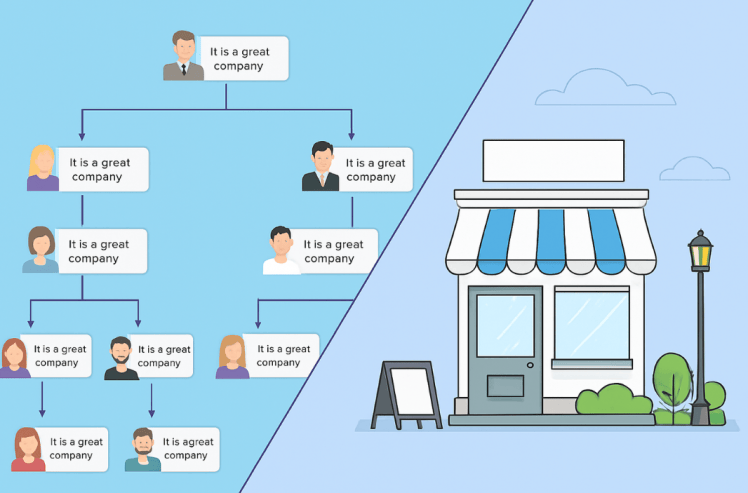
In this article, we’ll compare the traditional Brick-and-Mortar (B&M) business model with the Network Marketing (NWM) model and explore the key differences.
What is a Brick-and-Mortar Business?
A brick-and-mortar business refers to the traditional business model most people are familiar with.
It is typically a business where an entrepreneur or company provides a product or service from a physical location — such as a shop, office, factory, or other premises.
Examples include:
- Retail stores
- Restaurants
- Service providers
- Real estate offices
- Manufacturing businesses
- Independent contractors
These businesses usually require various functions such as:
- Research and Development
- Manufacturing or sourcing products
- Quality control and testing
- Packaging
- Marketing
- Sales
- Distribution
- Customer service
- Administration and accounting
A self-employed person may perform many of these functions themselves, while larger businesses may have entire departments dedicated to each area.
The Importance of Marketing
One thing all businesses have in common is that they need customers.
No matter how good a product or service is, people need to know it exists.
This is why traditional businesses invest heavily in marketing — whether through:
- Advertising
- Social media
- Newspapers
- Television
- Sponsorships
- Prime retail locations
A major part of the traditional business model is therefore getting the product or service in front of potential customers.
The “Time for Money” Model
Another defining feature of many traditional businesses is that income is usually directly connected to ongoing effort.
Employees exchange their time and skills for a salary.
Salespeople often earn commissions based on monthly or annual targets.
Self-employed individuals usually need to keep producing work or making sales to continue earning.
In simple terms:
When the work stops, the income often stops.
Even businesses that operate without a physical shop — such as independent contractors or gig-based services — generally follow this principle. When the activity stops, earnings usually stop too.
What is Network Marketing?
A legitimate Network Marketing (NWM) business shares many similarities with traditional businesses.
There are still products and services.
Those products generally still require:
- Research
- Development
- Testing
- Manufacturing
- Packaging
- Distribution
- Customer support
The major difference is not the product itself — it is the marketing and distribution method.
The Power of Networking
The key idea is contained in the name:
Network Marketing.
Instead of relying only on traditional advertising channels, many NWM companies use personal recommendations and word-of-mouth marketing.
Think about it:
When someone discovers a great product, service, movie, restaurant, or experience, they naturally tell others.
That simple process has always been one of the most powerful forms of marketing.
Network Marketing companies use this natural human behaviour by allowing Independent Distributors to share products and services with others — and earn commissions when genuine sales or subscriptions take place.
Independent Business Owners
A person who joins a legitimate NWM company is generally not an employee.
Instead, they operate as an independent marketer or distributor.
The company continues to handle the major business functions, such as:
- Product development
- Manufacturing
- Quality control
- Packaging
- Distribution
- Customer service
The Independent Distributor focuses primarily on connecting people with the products or services.
The Opportunity for Residual Income
One of the features that attracts people to Network Marketing is the possibility of creating a recurring income.
Instead of earning only from personal effort, distributors may also earn from ongoing product volume generated by their organisation, depending on the company’s compensation structure.
For example:
A distributor shares a product with several people.
Some of those people become customers and continue ordering.
The distributor may continue earning commissions from that ongoing volume.
As more people share the products, the organisation can grow — creating the potential for a longer-term income stream.
This is where the concept of leverage comes in:
A person is no longer relying only on their own hours worked, but can benefit from the combined efforts of a growing network.
Where the Two Models Differ
Both Brick and Mortar and Network Marketing businesses involve many of the same fundamentals:
- Product sourcing
- Research and development
- Testing
- Production
- Packaging
- Marketing
- Sales
- Distribution
- Customer care
- Administration
The main difference is found in:
Marketing and distribution.
Traditional businesses typically spend large amounts on advertising, sales teams, and physical locations.
Network Marketing companies often choose to redirect some of those marketing costs into rewarding Independent Distributors who help introduce customers to their products and services.
Building an Asset
A traditional job or sales role often resets each month.
Targets are achieved, commissions are paid, and then the process begins again.
A Network Marketing organisation, when built correctly, has the potential to become a growing asset — one that continues producing income from ongoing customer activity and team growth.
Like any business model, success depends on the company, the products, the compensation plan, and the effort of the individual.
Conclusion
Network Marketing is not a replacement for traditional business — it is a different approach to marketing and distribution.
Both models have strengths.
The opportunity in Network Marketing lies in using relationships, technology, and duplication to create a scalable business model.
The future of business continues to evolve — and understanding different models allows us to make better decisions.
Network Marketing is a powerful concept. Let’s learn, grow, and share responsibly.
Now that we’ve cleared up the difference between NWM and B&M, let’s look at “Why NWM?”
“Results in Network Marketing vary and depend on individual effort, skills, consistency, and the company’s compensation structure.”

